
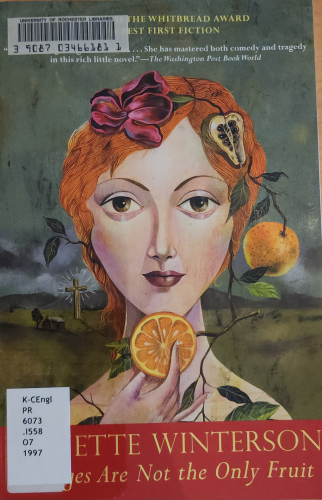
Once upon a time, there was a little girl. She had all the fixings and trappings of childhood. An overbearing mother, an absent father, and a firm belief in God. One day, when she was out and about as usual, she heard birds singing. Of course, they were explaining to her how to live her life.
Oranges Are Not The Only Fruit by Jeanette Winterson is a coming out story written in a gentle and matter-of-fact style. Jeanette (who is also the protagonist) tells you right off that bat that her mother is this way and this is the way she feels about this, that, and the other. Deeply religious, her faith in God makes up the majority of the reason behind her youth. Most everything Jeanette does is to further the end goal of becoming a missionary. Most everything anyway.
After this enlightening aviary conversation, the little girl went back inside to make herself some tea. Now, this tea took some time to make. The girl had to plant the tree and wait for it to grow, then pick its leaves and dry them, and only then could she finally set the tea to brew. All that time, she would sit outside and chat with the birds. They advised her on what clothes looked nice, and if friends were being kind, and if she had really meant such an awfully rude thing. In this way, the birds helped raise the little girl.
Through the book, the story cuts away to tell you a different story. These interspersed fairy tales are extremely interesting to me. They are about Jeanette and also the prince/princess/sorcerer's apprentice/little girl. Near the end of the novel, these interjections become more and more prevalent and start to leak into Jeanette's own story.
By this point, the little girl was more of a young woman. Having found her footing in life (with help from the birds) the young woman went out to talk to the birds one last time. Steaming cup of tea in her hands, she sat under the tea tree and struck up a conversation.
Even before the fairy tales become reality, Jeanette's mother and church have already decided that supernatural forces are afoot. They attempt to exorcise the demons from her and often bemoan that the Lord is punishing the church by using one of its most devout members to show why women should not head the congregation.
"Well, I suppose I should thank you. You've all made the last few years very much more bearable."
The birds sang a three note melody.
"And this might be the last time we talk. I'm leaving here tomorrow."
A chirp.
"But—oh gosh I should've written this down."
Triling.
The young woman leaned her head against the tree. She took a sip of her tea, which tasted strongly of buttered popcorn.
This story, which is really a handful of stories, is very listless in the way it is told. Demons appear to have chats and children are exiled from home. And yet the sinner is permitted return so long as everyone knows they're a sinner. I found this book of a young girl's "possession" quite relatable, so if I may, I'd like to offer some suggestions for dealing with possession.
"I'm just very grateful that you're listening is all. For once my skin feels like it fits alright."
The birds flutter in the trees as the young woman takes a sip of her drink. She can hear in another three a three note melody.
My advice is relatively simple. When someone thinks you are possessed, the first thing you should do is make yourself some tea.
