
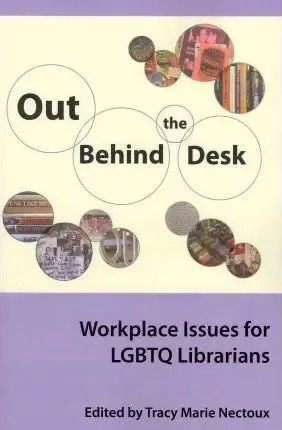
Near the very end of the Koller-Collins collection, at the end of the Z's, is an artifact of a time we are not long past. Published 15 years ago and edited by one Tracy Nectoux, Out Behind the Desk bears the weight of its years heavily on its spine. The contents of this book are fine enough, and some of the essays scratched their way out of the 2010's and into today relatively unharmed. This is not what I want to talk about.
The gender split between essayists is very nearly 50/50, barring a few unknowns. As one might expect of a book published in 2011, the primary concerns lie heavily with lesbian women and gay men, with one essayist being explicitly bisexual and another explicitly transgender. The book plods along, listing standard issues with discrimination and representation that queer folks faced (and still do) in library settings. Many of the essays are about bringing one's queerness into the workplace by encouraging events, curating collections, and pushing for a bit of reform. A handful of the essays leave a conformist taste in my mouth, that of striving to be one of the "good" queer people; other essays are a tad more open about the less mainstream aspects of queer sexuality, John P. and Shawn's in particular. Both of their essays are a good read.
No, that is not what I want to about either. These essays are extremely aware that same-sex marriage has not yet been legalized in the USA, and while this provides an interesting look into recent queer (American) history, it is still not what bothers me most about these essays.
What does bother me, like a shirt tag that will not cooperate, is the insistence that the acronym is "GLBT." Almost every single essayist used this version. Many of the organizations mentioned also used this ordering, most notably the GLBTRT (Gay, Lesbian, Bisexual, Transgendered Round Table, now called the Rainbow Round Table). While this isn't necessarily wrong, the core letters are still there, it is extremely odd.
For those who might not know, the acronym became "LGBT" around the 1990s. During the AIDS crisis, many people were cared for by lesbians, and to uplift this community, the "L" was moved to the front. Now, you might notice that some time has passed between the 90s and 2011. So why, then, do so many of the essays in this book use "GLBT"? I don't believe they all have some sort of misogynistic worldview they're trying to shelve alongside marriage equality. Nor do I think they're doing it maliciously to poke and prod the lesbian community. So why, then, "GLBT"?
I wish I had a clear answer. Would that I could ask each essayist why, in the writing of one essay 15 years ago, did they use "GLBT"? Unfortunately, I doubt I could reach them all in a timely manner, and I doubly doubt they would even remember. Perhaps they were just used to seeing old organizations use the phased-out acronym and just followed out of habit. Who can say?
So, I'll place this book gently on the return cart, with its odd use of acronym and mildly out-of-date issues, and head for home. The book is fine. The essays are well-written, and they all have a personality. You'll find it at the bottom of the shelf, right at the end.
Nectoux, Tracy Marie, ed. Out Behind the Desk: workplace issues for LGBTQ librarians (Duluth, MN: Library Juice Press, 2011). Koller-Collins Z682.4 .G39 O98 2011
