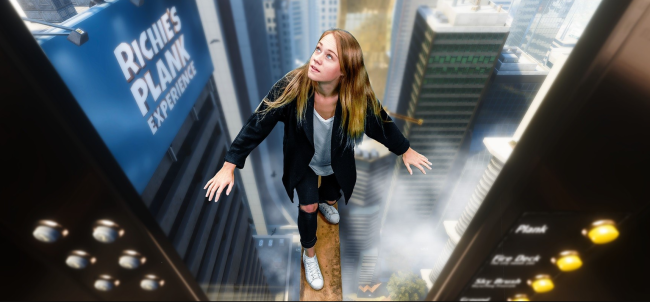
I stood completely frozen at the edge of what seemed like a digital precipice, my hands were starting to get clammy, and I felt myself getting increasingly disoriented as I stared down at an approximate 50-story drop from a narrow wooden plank. Every rational part of my brain reminded me that I was safe, standing on solid ground in a secure environment, and that this illusion was being caused by the VR headset. Despite this, the more I stared down, the more my body betrayed my knowledge: sweaty palms, quickened breath, and the overwhelming reluctance to step forward clouded my mind.
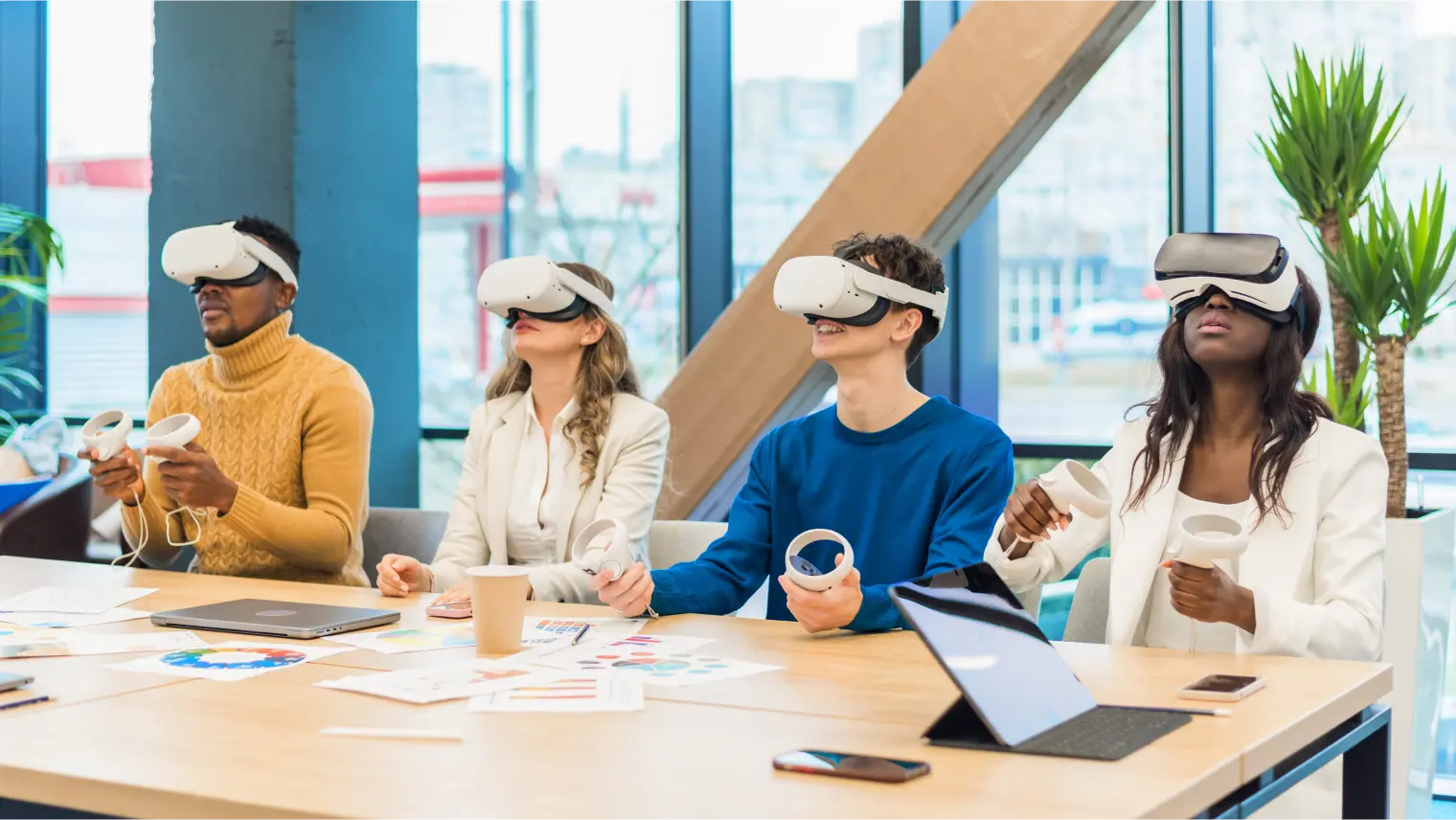
I found myself encountering this virtual plank experience like any other VR experience: I strapped on my bulky headset and tightened both controllers to my hands. Within seconds, I was transported into an elevator, revealing before me skyscrapers and a small wooden plank that extended across the space. The visual system was something like I’ve never seen before. Looking down, I saw a buzzing city, all contributing to the dizzying effect I was feeling. My vestibular system, which is a sensory system in the inner ear that detects head movements and spatial orientation to maintain balance and stability, fully bought the illusion of the plank, subsequently forgetting about the weight that the VR headset was causing and the room I just found myself in moments before. In that moment, Richie’s Plank Experience had my senses that I was in extreme and mortal danger.
But was I really? This question poses a significant stance within recently developed debates about virtual reality and how veridical it can turn out to be. Can virtual experiences be considered as “real” as non-virtual reality?
When I tried to walk towards the edge of the plank, my body had difficulty processing the fear I had of falling; it was authentic and physiologically measurable. Despite this, something crucial was missing in the midst of all my anxiety. There was no wind whipping around me as you would expect at such heights, no temperature change, no ear blockage from the change in pressure, nothing; no authentic sensory feedback beyond the visual and vestibular ones. Most importantly, there were no real consequences, no actual danger, and no serious physical stakes. If I were to fall off this plank, what would happen to me? I knew the fear was there, but underneath all that, I was subconsciously sure that at the end of the day, I would be perfectly fine.
Australian philosopher David Chalmers believes and argues that virtual experiences can indeed constitute and be considered genuine reality, as he states in his piece: Reality+: Virtual Worlds and the Problems of Philosophy. In his view, virtual objects and environments aren’t just mere illusions or simulations; they represent and constitute a legitimate form of existence. Chalmers states that in the process of interacting with virtual worlds, we are engaging with real digital objects that have authentic properties (bits) within their own computational space.
In his thesis, Chalmers suggests that the distinctions between what are the “virtual” and “real” worlds are less meaningful and significant than we thought them to be. He argues that virtual experiences can be just as genuine and valuable as their physical counterparts. If my experience is taken within the perspective that Chalmers proposes, my fear of the virtual plank wasn’t just a mere response to a simulation of danger; it was a real, emotional, and physical reaction to a real (albeit digital) environment.
The framework that Chalmers poses challenges the hierarchies in our minds about what counts as “real experiences”, suggesting that virtual reality doesn’t just represent a bleached imitation of our authentic experiences but a legitimate one and an expansion of what we consider our reality and the forms it can take.
Utilizing my plank experience to explore Chalmers’s theory helped me reveal the limits that exist within his arguments. While Chalmers makes a compelling case for the reality of virtual experiences, my body’s response told a more inconsistent story. While the visual and vestibular aspects of the experience were indeed convincing, the deeper parts of my consciousness remained aware that no genuine physical consequences were awaiting if I stepped off that plank.

This aspect of my experience isn’t simply a matter of current technological limitations that future generations of VR might eventually fix. The absence of real physical stakes and the knowledge that I couldn't actually fall off that plank and die represents a fundamental and categorical difference between VR and non-virtual reality that no amount of sensory sophistication and cutting-edge technology can be capable of fixing.
This limitation serves as a fundamental definition of what virtual reality is: a powerful tool for creating specific types of experiences within limited bounds, not interchangeable with our real world. Recognizing and understanding these boundaries doesn’t diminish the power that VR has; it just helps us collectively appreciate both its achievements and its limitations.
Perhaps the most honest answer to the question of whether virtual reality can be considered real or not is both yes and no. Yes, within specific sensory domains and for particular types of experiences, and no when it comes to the full complexity of physical encounters. Richie’s Plank Experience taught me that reality, just like truth, comes in degrees, and virtual reality excels at delivering certain degrees while falling short on others.
With the advancement of high-tech and the creation of more sophisticated technology, we’ll undoubtedly push the boundaries of VR and the “real” world further. But if my experience makes one thing clear, it’s that the meaningful distinctions between virtual and physical reality are not just one of those technological challenges to overcome, but a fundamental feature of what makes each domain unique and valuable.
Image Sources
Headline Image
Image 1
Image 2