
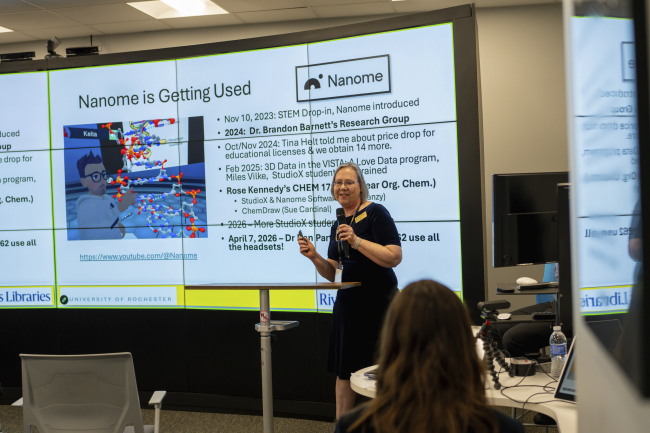
"As an organic chemistry student, Sue had a tough time with the 3D representation of molecules." — Sue Cardinal, Lead STEM Librarian, URochester
That struggle sparked a years-long journey to find something better — and eventually led to an XR Studio full of chemistry students seeing molecules in a whole new way.
A Library in Transition
The journey began when Carlson Library's reference area was converted into Studio X, an augmented and virtual reality laboratory. For Sue, it was an opportunity she hadn't expected.
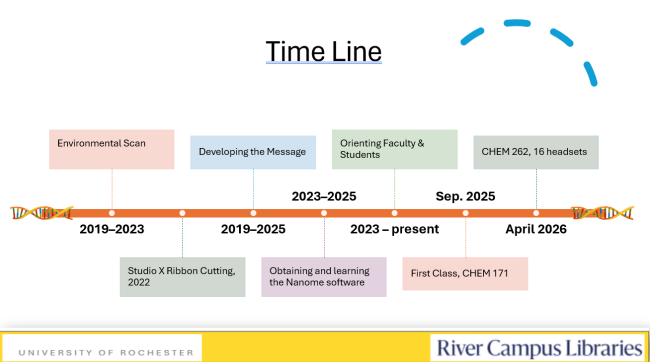
She had recently been exploring extended reality (XR) technologies, and in fall 2019 she co-organized a symposium on XR at the American Chemical Society's national meeting in San Diego. What she and her colleagues heard from peer institutions was clarifying: libraries are a natural home for XR, and institutions like the University of Illinois, Caltech, and the University of Florida were already putting these tools to work in science education.
Discovering Nanome
The breakthrough came in August 2021, when Sue's colleague Tina Qin presented a poster at an ACS meeting describing how her team at Harvard was using Nanome — a VR platform built specifically for visualizing and interacting with molecular structures. Sue took the discovery straight to Studio X Director Meaghan Moody, who agreed to purchase two licenses. That was the beginning.

Building Momentum
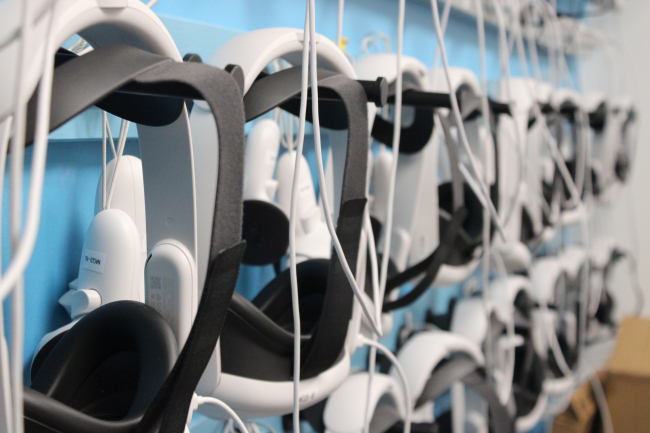
What followed was the kind of gradual, community-driven rollout that real technology adoption looks like. Joe Zelazny and student worker Miles Vilke — both on the Studio X team, with Miles serving as XR Specialist — learned the software together and began training faculty and students alongside Sue. Dr. Brandon Barnett's research group started using Nanome in their work. Building on early success, the library expanded to 14 more licenses, bringing the total to 16 VR headsets.
The program grew from there. A Love Data Month event in February 2025 introduced Nanome to new audiences. Dr. Rose Kennedy brought her CHEM 171 students to Studio X to experience it firsthand. More student educators were trained, extending the program's reach further. Studio X also welcomed Nanome CEO Steve McCloskey as part of its Voices of XR speaker series, bringing the perspective of the platform's creator directly to the community.
Full Capacity
Then came the day everything clicked into place. Dr. Ben Partridge's CHEM 262 class arrived at Studio X, and for the first time, all 16 headsets were in use at once. Students were rotating, zooming into, and manipulating molecular structures in full three dimensions, no flat diagrams.
It was the moment Sue had been working toward. An intuitive way, at last, for students to truly see the molecules they study.
The experience also offered a practical lesson: smaller groups, led by a facilitator such as a TA, tend to yield a better experience than a full room.
The Bigger Lesson
This story is really about what it takes to introduce new technology into an academic setting. It takes patience, faculty partners willing to experiment, student educators willing to learn and teach, and institutional support that keeps saying yes. The timeline from first idea to full classroom adoption spanned years — and that's normal.
But when it finally comes together, it's worth every step. To learn more about how to use and access the Nanome app at Studio X, visit the Chemistry LibGuide.
This post is adapted from a lightning talk presented at the XR Research Symposium, May 1, 2026.
