
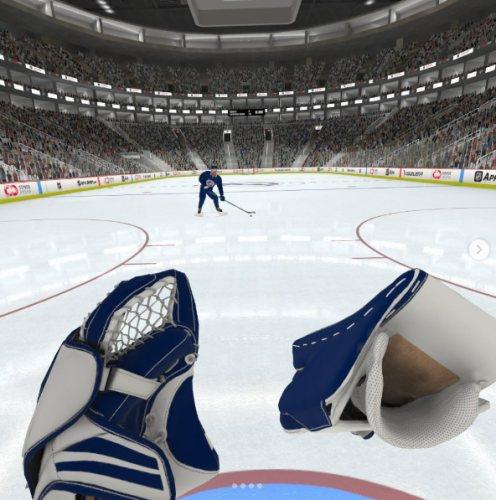
In 2022, I had the opportunity to get a kit from Sense Arena, a company specializing in VR training for hockey and tennis athletes. Their interface for hockey goaltending is fascinating, combining statistical analysis with real world videos of athletes (ranging from 14 year olds to NHL players) and movement meant to mimic on-ice reaction time. The user is meant to strap 3D-printed holders onto their glove and blocker, insert the Meta Quest 2 controllers into them (or use the controllers alone), and simulate making saves with their hands.
It’s an intriguing experience.
The videos combined with haptic feedback from the controllers makes for a surprisingly realistic experience, and one that Sense Arena claims improves the save percentage of goalies by over 10%. Despite my limited use of the technology, I found that it felt like meaningful training to improve my hand-eye coordination.
Yet, I’ve seen hardly anyone else adopt the use of Sense Arena for hockey. Even high-name NHL and PWHL sponsorships don’t seem to help. Growing up in Eastern Massachusetts, I’d expect someone to use it, right?
In my opinion, the lack of adoption of VR in hockey training boils down to 2 main reasons:
- Cost - The technology is quite expensive compared to most VR applications, requiring the purchase of both the 3D-printed holders and a subscription to the Sense Arena app.
- Effectiveness - While the technology generally improves hand-eye coordination skills, it struggles to replicate more precise conditions hockey players experience on the ice.
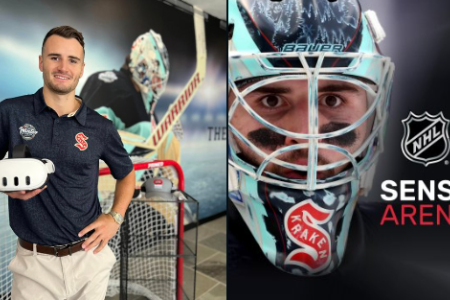
The first factor, cost, introduces an odd paradox. Hockey is already an expensive sport, so it can be argued that for a well off hockey family, the cost of Sense Arena and its associated technology wouldn’t be a large financial burden. Yet, families who struggle with hockey’s high cost cannot afford to spend even more on Sense Arena’s high costs. For goalies, this problem is amplified because of the higher cost of both goalie equipment and the technology needed to use Sense Arena in its most realistic fashion.
Furthermore, it's usually easier to access the technology if families already have a VR headset, rather than purchasing a headset specifically to use Sense Arena. I already had a Meta Quest 2 before using Sense Arena, and even then I didn’t use the headset much to train.
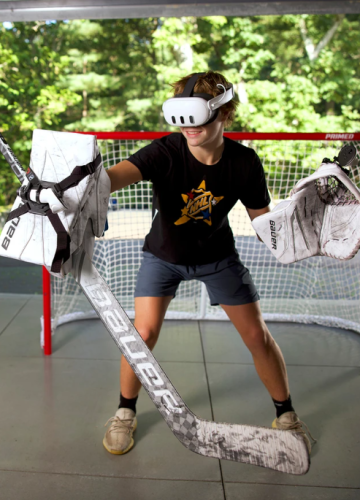
Sense Arena uses a subscription model to soften costs, but its nature creates problems for families whose income may not be guaranteed. At 59$ a month (or 29$/month if you purchase a year's worth for 354$), the subscription certainly isn’t cheap for families who are already spending thousands of dollars a year on equipment, travel, and team dues. Even for families who could afford the technology, it still isn’t commonly used.;
The second problem - effectiveness - reveals a deeper part of the broader issue plaguing VR sports training.
In the context of hand-eye training specifically, research has shown that VR technology can benefit hand-eye coordination and reaction time. A 2016 opinion article by neuroscience researchers Mel Slater and Maria Sanchez-Vives (titled “Enhancing Our Lives with Immersive Virtual Reality”) references studies into this idea, specifically a 2013 study by psychology researcher Cathy Craig that covers what Craig calls “perception and action in sport”, where “[Craig] argues that VR offers some clear advantages for [perception and action] and gives a number of examples where it has been successful”. This is what Sense Arena specializes in, so points given there.
Craig’s claim that “Another advantage of VR would be to train players to notice deceptive movements in opponents, by directing attention to specific moves or body parts that signal such intentions” also applies to Sense Arena. The videos of real-life players shooting pucks lets the user distinguish between subtle differences in release angles and torso movement that differs slightly depending on where the shooter aims the puck. Even though I didn’t do a lot myself, repeated use of the technology could improve the ability of goaltenders to predict shot locations using the physiology of a shot release.
So does VR work at improving hand-eye coordination? Yes, and it also trains reading movements from opponents.
Yet, the technology is still incapable of simulating the conditions required for training athletes’ mindsets. The same Slater and Sanchez-Vives paper references two studies by Mathias Wellner et al. that cover both virtual audiences and opponents. For a virtual audience, Wellner “did not find a notable outcome in this regard”, while in the case of simulated opponents, they found that “No definite results were found, but according to the authors, the study had some flaws”, with Slater and Sanchez-Vives adding that “it is important to note how VR affords the possibility to experiment with such factors that would be possible, but logistically very difficult to do in reality”. The ‘factors’ they refer to include the lack of pressure to fully compete (athletes know the situation isn’t real, and thus may not push themselves as much), the lack of physical feeling when making saves (which is incredibly important for goalies to direct rebounds away from the net), and the different movement as compared to being on ice (Sense Arena doesn’t train skating, so users must step to move their feet, which could create a habit that doesn’t actually translate to on-ice movement).
Basically, VR cannot yet simulate the exact conditions athletes compete under. This conclusion could explain why so few athletes have adopted VR technology in general. While it can hone specific skills, it can’t faithfully replicate the conditions experienced when practicing on real ice with in-person coaches and teammates. Like Slater and Sanchez-Vives mention, this is an incredibly difficult problem to fix, and for the meantime, it's easier (and often cheaper) to train in real life.
At the end of the day, VR certainly has benefits for athletes, especially ones who rely on hand-eye coordination. However, the technology can’t create a mindset and environment that mimics real-life competition, and suffers from high costs, all of which contributes to its lack of use among average hockey athletes. Right now, I don’t believe the benefits outweigh the costs, especially for less well-off families. If it becomes cheaper, perhaps we’ll see more players adopting Sense Arena for hockey in the future.
Image Sources:
Headline Image
Image 1
Image 2
