
You're in the place you’ve always dreamed of, and you take a step forward – but suddenly the world glitches. You’re stuck. You try to walk, but nothing happens – you can't move. As you start to panic, reality hits you – this isn't real. All you have to do is press a button and exit. Every danger, risk, and sensation is under your control; a world you completely manipulate. David Chalmers argues that VR is as real as the Physical Reality. He believes that what happens in VR can be meaningful because of your experiences, from what you see, hear, and feel. VR worlds are not truly real, even though your experience might be. However, they are more of a simulation, since users can manipulate and control their realities without limits or restrictions, which prevents them from gaining meaningful experiences where they develop real-world skills and understanding.
Usually in VR, people experience things that most likely don’t occur in the physical world. Or they experience things that might be completely impossible to do, which makes it difficult for VR “realness” to stand with the same “realness” in the physical world. In Chalmers' article, he says, “I’ve flown like a bird. I’ve traveled to Mars. I’ve looked at a human brain from the inside, with neurons all around me.” This shows how, in the physical world, you're not able to do whatever you desire; you cannot completely control your experiences because it is filled with randomness and unpredictability. In the virtual world, what you experience is real, but it is still not the real physical world if it's designed by you, according to your needs and wants. A real, physical world is a place that has consequences, risks, and unpredictability that you did not design.
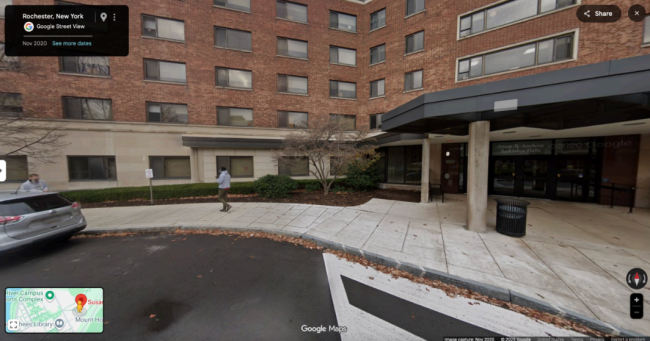
As a college student, living on campus and away from home, one of the first thoughts I had with VR was to visit home. I wanted to look at my house, my sisters and cousins' bicycles, and my car, so I went on maps and tried to experience it. It felt real for a minute, until the screen to visit other places popped up. I made that screen go away, but then I realized, I couldn’t walk towards my house, and the screen was much blurrier than how I see my house in real life; there were too many distractions to make it seem even a little “real”. Even a clear picture from Google Maps street views of a residence hall (the picture above) shows how clear the physical world is, which VR cannot replicate the clarity, resolution, and sensory details. Eventually, time was up, and I had to come back to my physical reality.
You always come back from your VR to your physical reality. Eventually, no matter what, you have to take off your VR headset to come back to the physical world, whether it's for sleeping, eating, or going to the gym. You breathe in your physical reality, something that can’t be done through a virtual headset or in a virtual reality. The physical reality has many aspects that cannot be done in VR, which makes it not a real reality. The physical reality has laws that you have to follow, compared to a virtual reality where you create the laws, making a huge difference in their “realness”.
VR allows you to make many worlds–worlds completely shaped by your desires–but that doesn’t necessarily make them real. These worlds are manipulated by the people using the VR. For example, in the physical world, you could’ve had a really harsh friendship breakup, and it's just impossible to gain that friendship back, no matter how hard you try. However, you could easily change that with VR; you could create a new world in which you are preventing what caused the friendship breakup, but that doesn’t mean you are friends with them in the physical reality. You are the one controlling the VR world with your desires; your ex-friend in the physical world will not even know this is happening. Chalmers notes, “Once simulation technology is good enough, these simulated environments may even be occupied by simulated people, with simulated brains and bodies.” In this case, your ex-friend in the physical world exists in your virtual reality as a simulation. Perhaps you will retain your friendship in VR, hang out, and make new memories with that friend. But when you come back to the physical world, your friend won’t actually be your friend.
In this world, you learn how to live. You gain skills and wisdom from your negative experiences. But if you go into a world you desire, you won’t learn about life because everything goes the way you want it to. Chalmers says, “The truth matters. There are truths about reality, and we can try to find them. Even in an age of multiple realities, I still believe in objective reality.” Even if VR feels real, you can’t replicate the single external reality. Unlike VR, the physical world has restrictions and constraints that cannot be escaped, which teaches us how to act in situations that we are not fully in control of. In a place where you live how you want and manipulate your “fate”, you might fail to grasp the deeper significance of things, such as appreciating little things and learning the value of effort. You never learn how to deal with some emotions, like frustration, sadness, and other uncomfortable emotions.
In conclusion, virtual reality is a real experience, but that doesn’t make it a real world. There are many worlds you can create; however, you only come back to one. You can manipulate thousands of worlds, but the one that teaches you real-life skills is the one you cannot control. VR worlds are a simulation; they are manipulated by you.
Works Cited
Chalmers, David J. Reality+: Virtual Worlds and the Problems of Philosophy. W. W. Norton & Company, 2022. consc.net/reality+/excerpt.pdf. Accessed 25 Sept. 2025.
"Street View of Susan B. Anthony Residence Hall." Google Maps, Google, 25 Sept. 2025, www.google.com/maps/place/Susan+B.+Anthony+Hall/@43.1297817,-77.6267662,17z/data=!3m1!4b1!4m6!3m5!1s0x89d6b4c64336edf9:0x3ae583c913b9d80b!8m2!3d43.1297817!4d-77.6267662!16s%2Fg%2F11bwkdkdjx. Accessed 25 Sept. 2025.
Image Sources
Headline Image
