A more sustainable, searchable home for books published in English translation
The Translation Database redesign transformed a long-running open-access resource into a more sustainable, accessible, and user-friendly platform. Digital Scholarship reworked both the public website and the system behind it, improving navigation, search, data structure, and editorial workflows while making the collection easier to browse, maintain, and use for research.
What is the Translation Database?
The Translation Database is an open-access resource for discovering books published in the United States in English translation. Founded in 2008 by Three Percent and Open Letter Books at the University of Rochester, the database focuses on first-time English translations, helping readers and researchers understand which authors, languages, countries, and publishers are bringing new voices into English. Today, it includes more than 11,000 works across fiction, poetry, nonfiction, and children's literature.
The problem
When Translation Database curator Chad Post connected with Digital Scholarship through River Campus Libraries librarians, he was looking for more than a new website. The project's underlying database and editorial process had become difficult to maintain, while the public site made searching and browsing challenging for many users.
Our process
Digital Scholarship began by working with Post to understand how the Translation Database was being maintained, who used it, and what those users needed from it. We reviewed the existing site using user experience and interface design practices and mapped the editorial workflow behind the scenes.
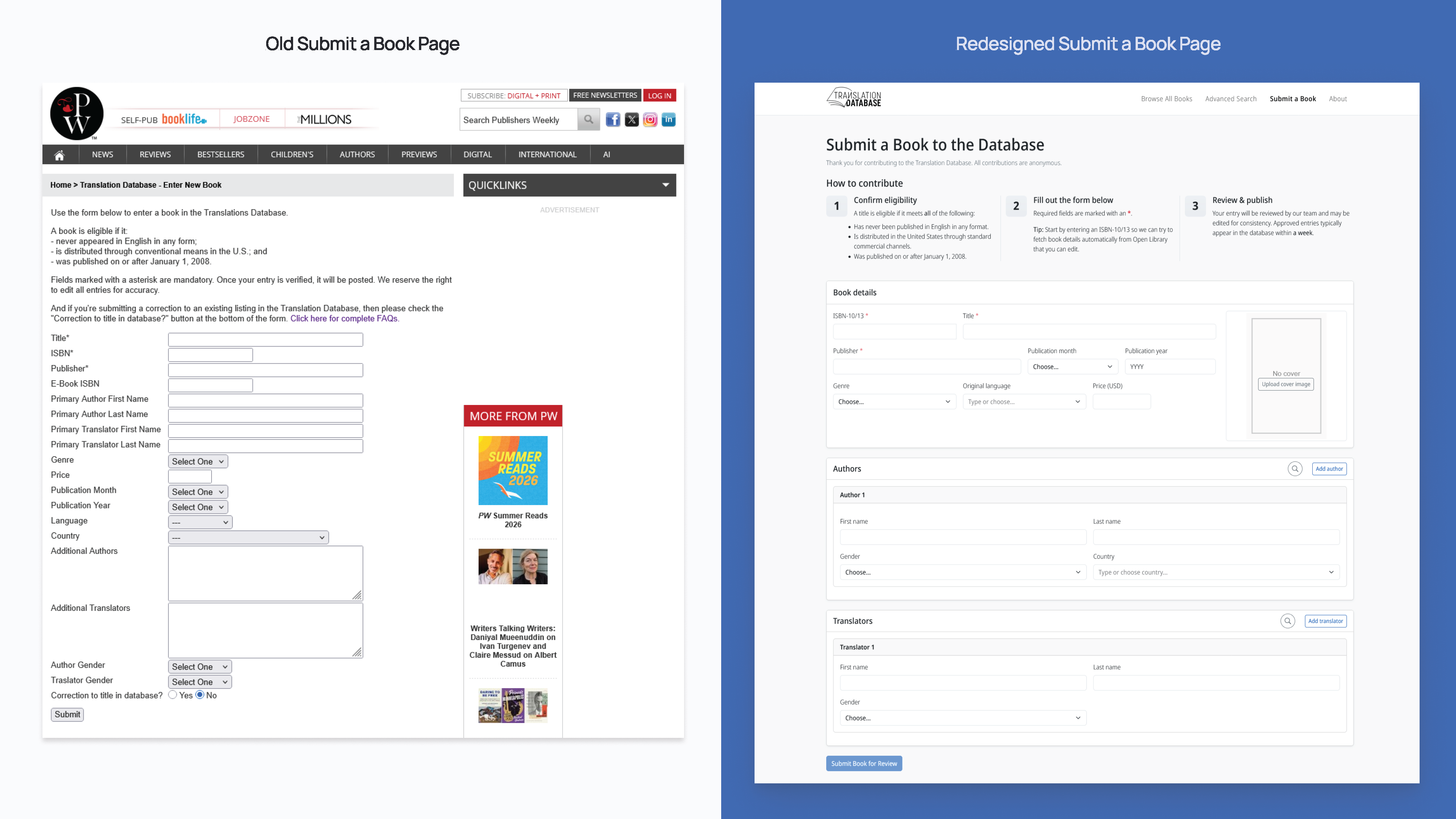
That process revealed several connected challenges. Post maintained the database locally in FileMaker, while new titles arrived through email and Google Forms and data had to be manually exported for use by Publishers Weekly. The database structure also made complex records difficult to represent consistently—for example, only one author and one translator had dedicated structured fields, leaving additional contributors to be recorded in general notes.
Rethinking search and discovery
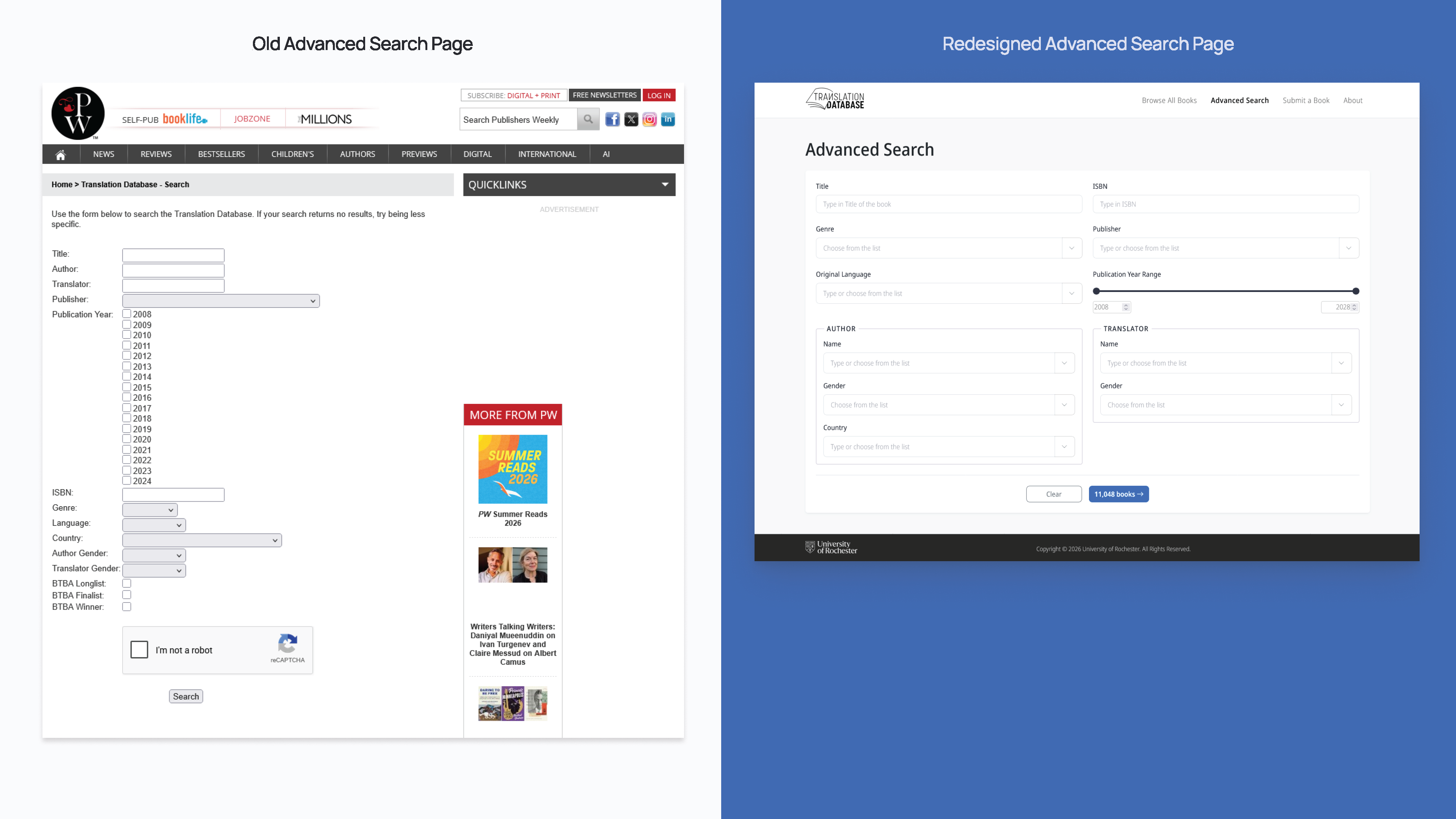
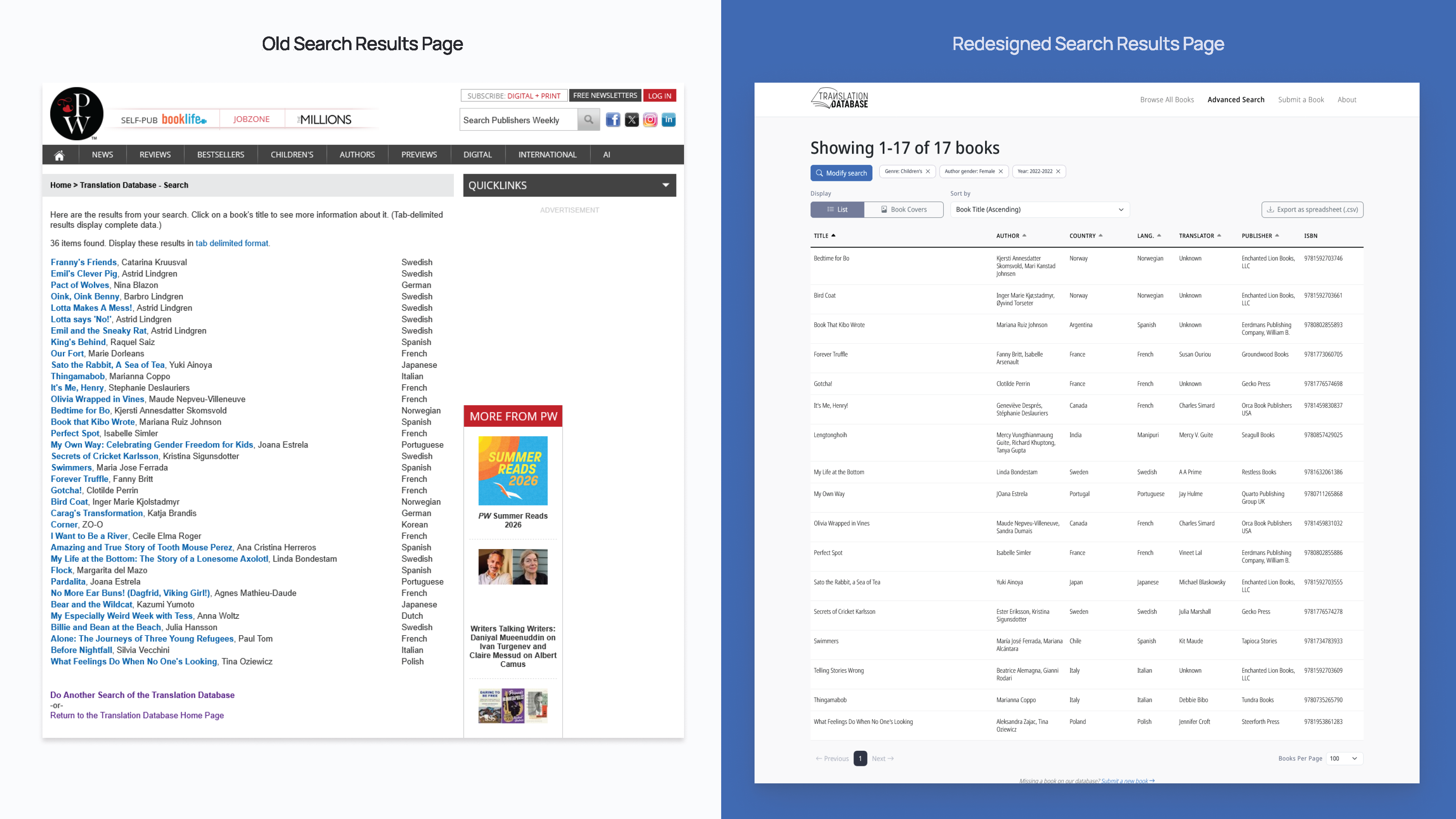
The public-facing experience introduced another kind of friction. Users had few ways to navigate the site and generally had to use a large advanced search form to find books. Searches required a reCAPTCHA and could return empty result pages, sending users back through the process. When results were available, long and densely formatted tables made them difficult to scan and compare.
These findings led us to approach the project as a redesign of the entire system rather than simply a visual update.
The Redesigned Experience
Building a more sustainable system
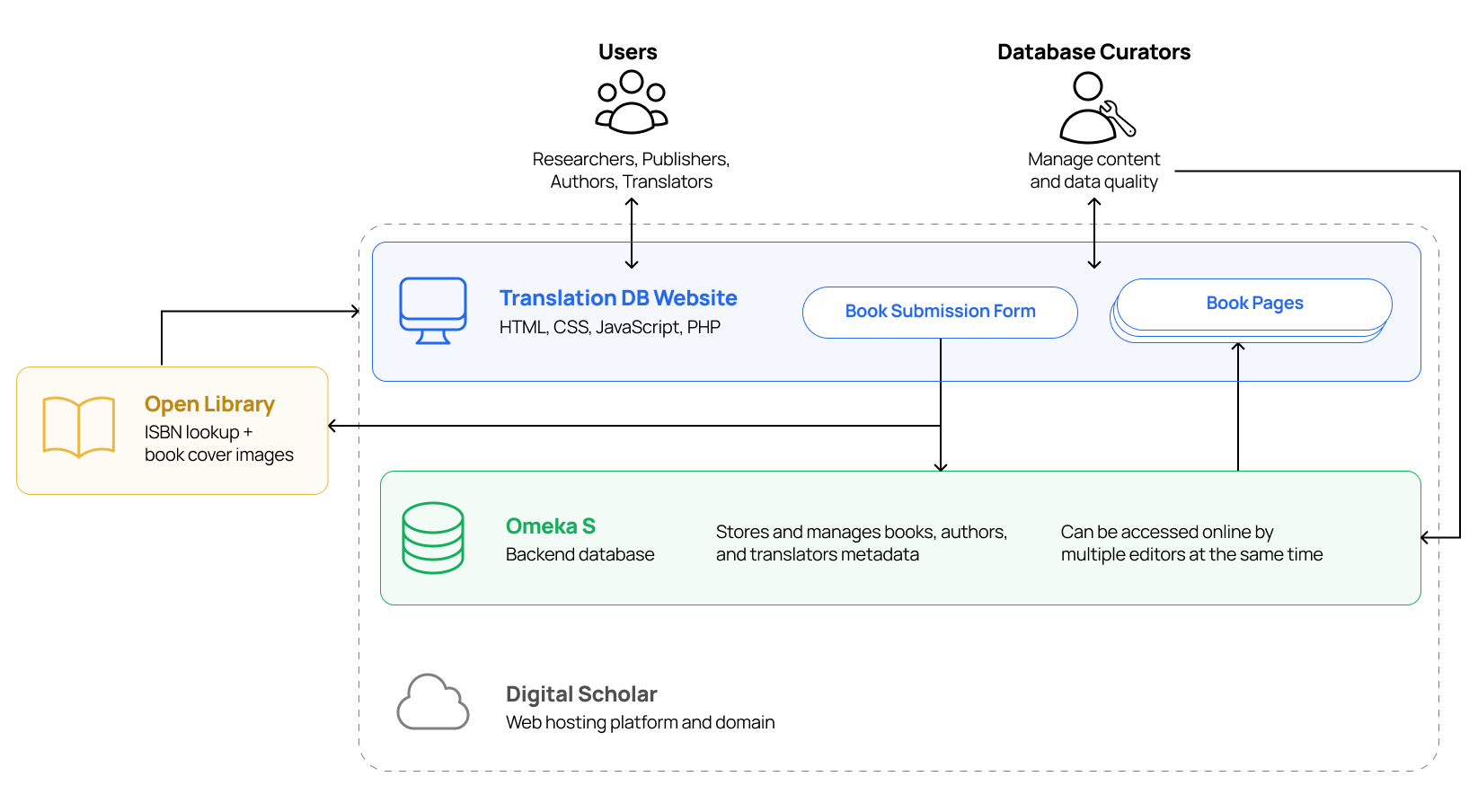
We proposed a new architecture that separates database management from the public website. The collection was moved to Omeka S, where books, authors, translators, and other metadata can be managed online by multiple curators simultaneously.
A separate public website, built with HTML, CSS, JavaScript, and PHP, retrieves that data from Omeka S and presents it through an interface designed specifically for Translation Database users. Both are hosted by Digital Scholarship's Digital Scholar web-hosting platform.
Reducing manual data entry
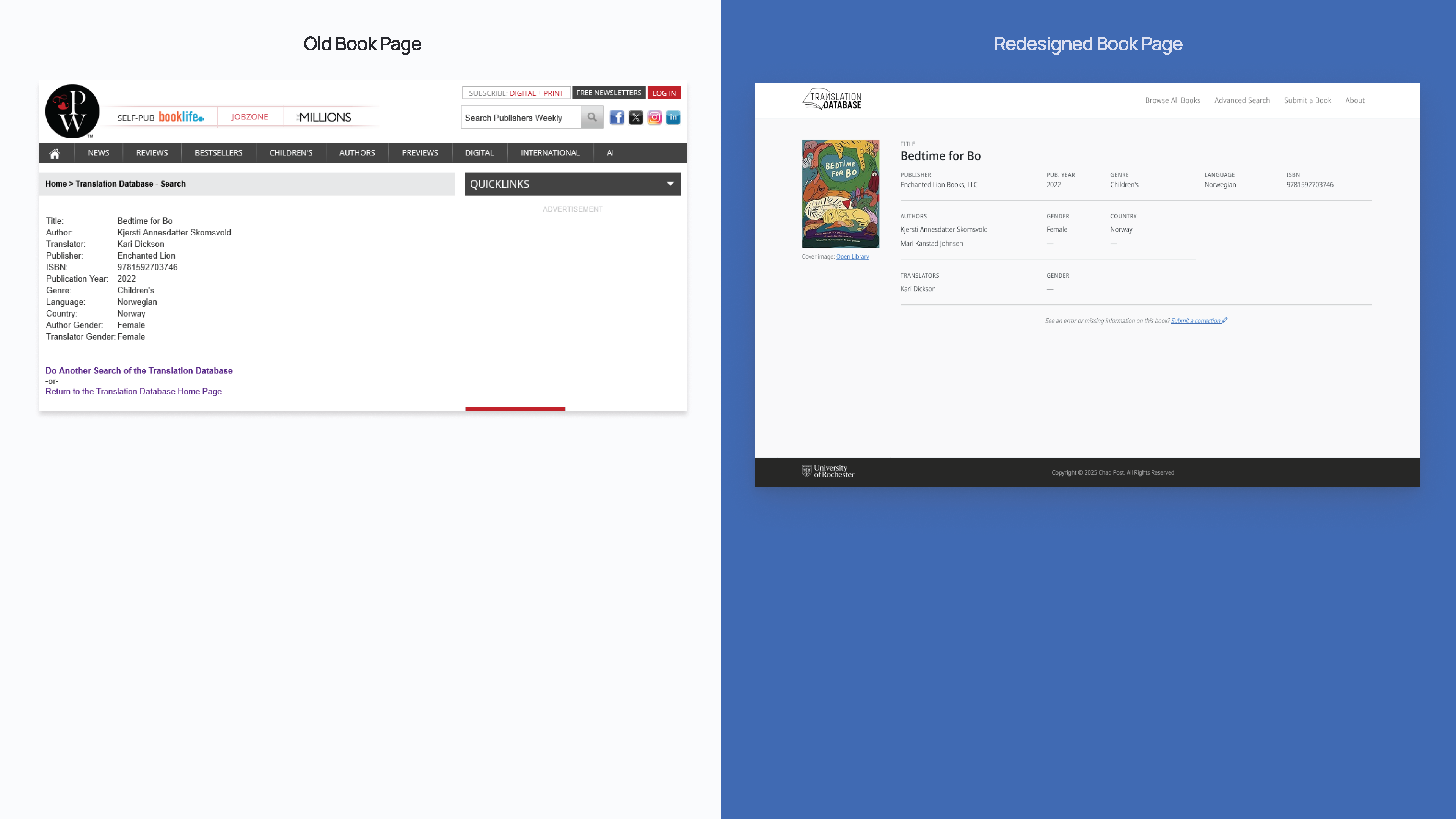
The new workflow also connects with Open Library. ISBN lookups can help populate book information and provide cover images, reducing repetitive data entry while giving curators an opportunity to review information before publication.
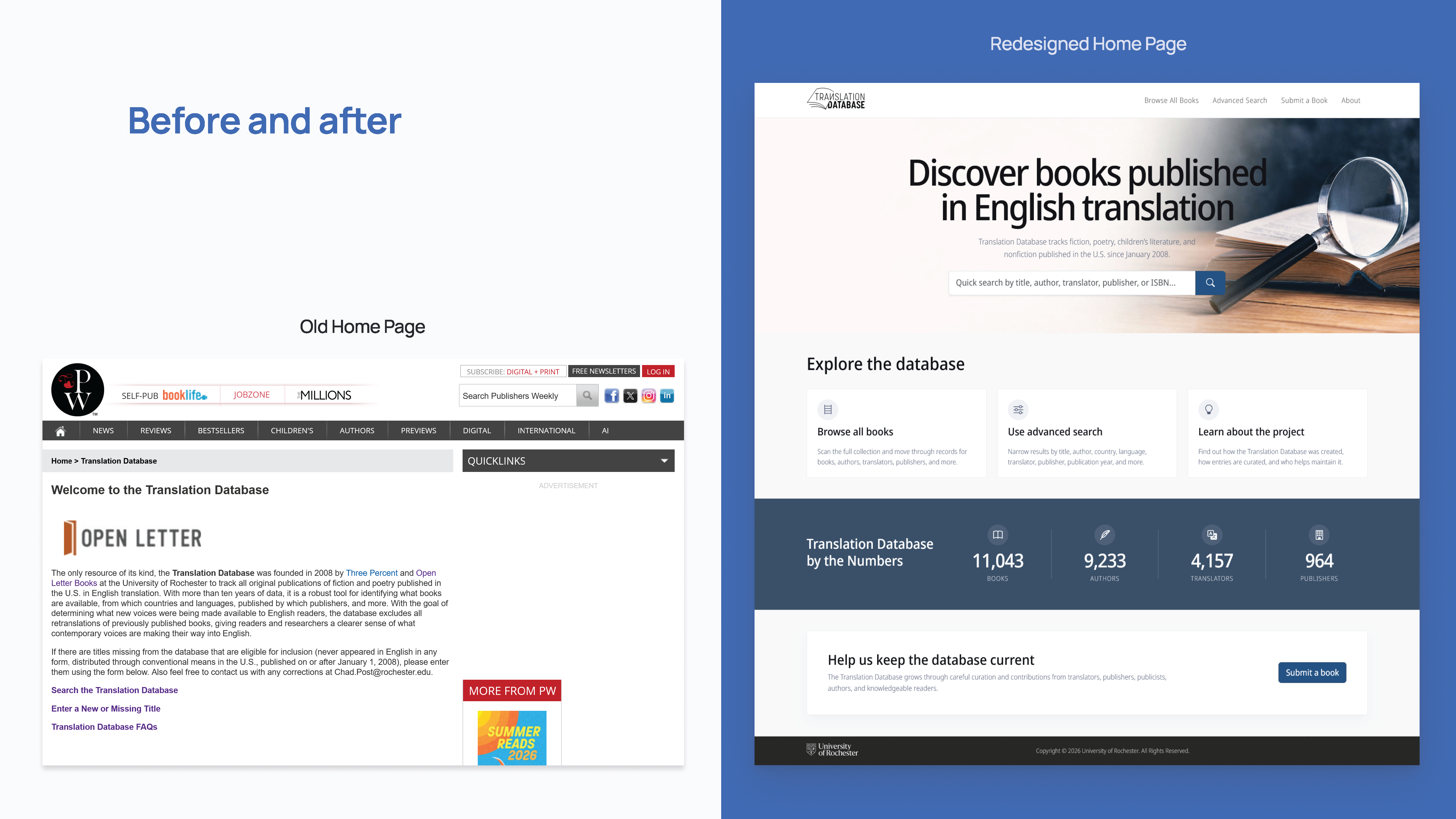
The cover images also make the collection easier to browse visually and help turn what was once a dense, text-heavy database into a more approachable discovery experience.
Designing for different ways of exploring
On the public site, users can now choose how they want to explore the collection. A quick search helps people who already know what they are looking for, while Browse All Books lets them explore the collection without first constructing a search
Advanced search and filters support more focused research by fields such as author, translator, language, country, publisher, genre, and publication year. Results can be viewed and sorted more clearly, browsed with book covers, or exported as a spreadsheet for further research.
Before & After
Improving the editorial workflow
The redesign also addressed the other side of the database: contributing and curating records. The new submission workflow provides a more structured way to represent multiple authors and translators, while Omeka S gives curators a shared environment for reviewing and maintaining records.
This is particularly important for a resource that grows through both ongoing curation and contributions from translators, authors, publishers, publicists, and knowledgeable readers.
Making the data easier to reuse
Another goal of the redesign was to make the data itself easier to reuse as scholarship. The Translation Database is now connected to the University of Rochester Research Repository (URRR), where researchers can find citation information, its DOI and license, and options for downloading the dataset.
What's Next?
The redesigned Translation Database is now live, but the project is still evolving. The team will continue to gather feedback from the people who curate and use the database and refine the experience based on what we learn.
Future development includes:
- Exploring data visualizations to help researchers see patterns across the collection
- Improving search and filtering with a more robust search technology, such as Solr
- Investigating integration with Primo to supplement book-cover information not available through Open Library.
