
The River Campus Libraries (RCL) is pleased to announce a 7th round of Zero Cost Heroes (ZCH). Please see the heroes of our first, second, third, fourth, fifth, and sixth rounds. We are proud to highlight an array of cost-saving heroes over the years who encompass faculty, instructors, researchers, staff, and students - both graduate and undergraduate.
For a variety of reasons, all our selected heroes have chosen to create, modify, or adapt course materials that are free to use at URochester and worldwide. In previous rounds, we highlighted several heroes in one week. This year, in continuation of this series, we are showcasing one hero. For all Zero Cost Heroes, we share their motivations for championing free and open educational materials and what their students have to say about them.
Spotlighting Zero-Cost Heroes is part of an ongoing RCL effort to ensure equity, access, and empowerment for all URochester students. Other examples of this effort include the ACT commitment and much of what is on the Open Education Services page, where you can view presentations from our OER and Open Pedagogy workshop series.
Interested in exploring OER by discipline? Check out this new OER compilation.
Want to nominate someone as a Zero-Cost Hero? Submit here.
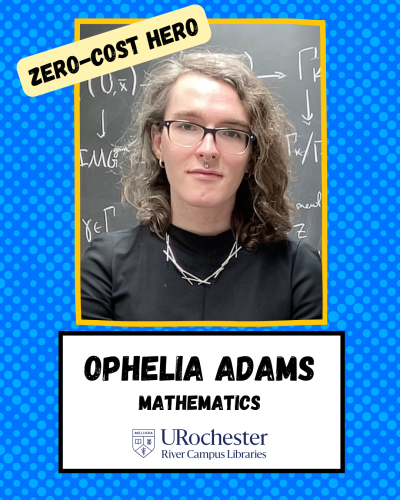
When Ophelia Adams was teaching MATH 280, “Introduction to Numerical Analysis,” the assigned commercial textbook did not present the course material in its order of content and other ways Ophelia preferred. In the past, she assigned about 1/3 of the text out of sequence. To ameliorate everyone’s experience in this course, Adams, with assistance from three students, Yuankun (Kunko) Zou ’27, John Nguyen ’25, and Yu Xin ’25, developed a Numerical Analysis supplementary text for MATH 280.
To produce this supplementary text or “course notes,” Adams received funding from the Teaching Center’s College Course Development, Student Course Development Project and the River Campus Libraries’ Open Education Grant. Although parts of the commercial textbook were used in the Fall 2024 course, the textbook supplement ultimately replaced it as the main course material.
When asked why Adams is interested in open course materials, she responded, “Math has a strong open access tradition and research [in this discipline] from the 90s and beyond lands on arXiv in preprint form. It’s a benefit [to mathematical research] to get to the materials quickly. We should advance educational materials in the same way. For an educational resource, it’s valuable to share with others to adapt as they see fit.” Instructors develop supplemental material all the time, and when making course materials open, they can share them online with the world for others to benefit from, with the option of adapting as needed.
Besides funding, Adams appreciated the support received from librarians. From various correspondences and consultations about topics such as open educational resources (OER), open licensing options, and publishing platforms such as Quarto, all benefited her in this project. In this course notes text, she used Python programming, and as a result, she believes it helped her 25 MATH 280 students in their final programming projects. The assigned commercial textbook includes examples that are more like pseudocode than actual code, and it was beneficial for students to learn with real code examples.
As for her research, the experience of making open course materials inspired her to convert all her research papers on ArXiv from PDF to HTML format to make them more accessible. She reflected that most OER are in HTML format, which not only makes the content more accessible and lowers barriers to access for all, but also makes it easier to correct errors and make updates.
As a spinoff from Adams’ MATH 280 course notes, she developed an interactive OER teaching the “monodromy method”. Using GitHub and reflecting on the experience, she said, “Originally, I made a simpler version of these visuals for the text, but I had a lot of fun expanding it into this more substantial tool. Much of my research is about monodromy, and it's a fun way to introduce it to other people (a student of mine used it in a presentation!)”
When asked what advice she would give to other faculty who are thinking about teaching with an OER, she says, “Just do it. It has a lot of advantages. If you take an existing, stable OER, it won’t be much different from a commercially licensed textbook, with the exception of having more flexibility and control over what and how you teach.” In effect, it made the course not only easier to teach but also facilitated student learning by presenting the content in an alternate, preferred order, with real examples, while including students in the creation and adjustments of the content.
