
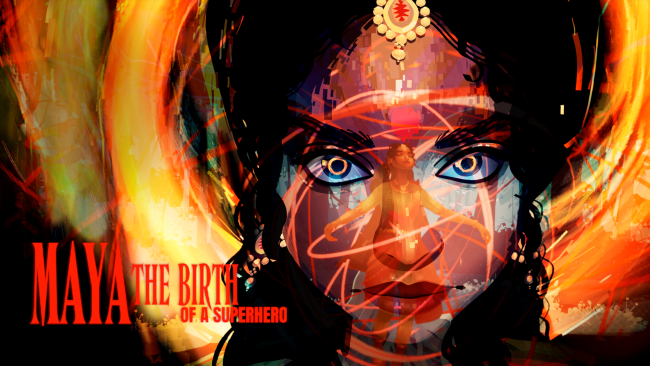
"The storytelling has to be so strong that you forget you are using tech."
Where Storytelling Meets Technology
Speaking to students at URochester as part of the Voices of XR Speaker Series, immersive artist and filmmaker Poulomi Basu returned repeatedly to a simple idea: immersive technology is most powerful when storytelling and technology work together to create experiences that neither could achieve alone.
During her visit to Studio X, Basu centered her discussion on Maya: The Birth of a Superhero, her award-winning immersive project exploring menstruation taboo and gendered violence in Nepal. Through Maya, she showed how embodiment, interaction, sound, and narrative can confront systems of stigma, power, and social inequality rather than simply simulate experience.
Shame Into Transformation
Maya is inspired by the practice of menstrual exile in parts of Nepal, where women and girls are isolated during menstruation because of longstanding cultural taboos. In Basu's retelling, shame becomes transformation. The project reimagines the superhero origin story through a feminist and decolonial lens, inviting participants into an embodied journey that blends mythology, sound design, environmental interaction, and symbolic ritual. In The Guardian, critic Charlotte Jansen described it this way:
"Whether you have menstruated or not, this brings you closer to what it is like, and how it might be seen differently."
Storytelling as Embodied Activism
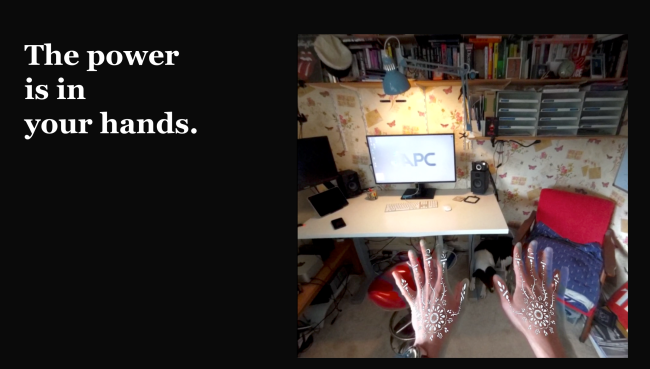
Basu framed immersive storytelling not as spectacle or escape, but as a deeply human medium rooted in emotion, memory, and participation. Rather than positioning technology as a shortcut to empathy, she emphasized uncertainty, embodiment, and agency. She spoke about "embodied activism," the politics of representation, and the importance of designing experiences where audiences feel genuine agency within a story. As one slide put it:
"The power is in your hands."
Conversations Across Disciplines
Basu's visit included presentations, demonstrations, and conversations with students and faculty across anthropology, public health, and digital media studies. Her sessions were integrated into ANTH 223: Anthropology and Public Health, taught by Dr. Tali Ziv, and ANTH 216: Medical Anthropology, taught by Dr. Ray Qu. For students already examining questions of health, inequality, embodiment, structural violence, and ethnographic practice, Basu's work provided a compelling real-world example of how immersive storytelling can engage with complex social and cultural issues.
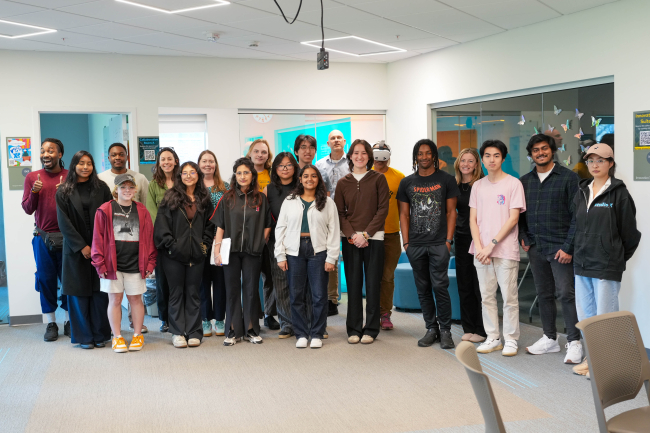
The personal dimensions of the work surfaced throughout. After the event, Basu spent time with Studio X student workers Aadi Rajbhandary, a student from Nepal, and Emmie Lin, whose conversations grounded the project’s themes in lived experience.
She also reflected on fathers who, after experiencing Maya, told her it helped them connect more deeply with their daughters — a reminder that the most lasting impact of immersive storytelling often happens after the headset comes off.
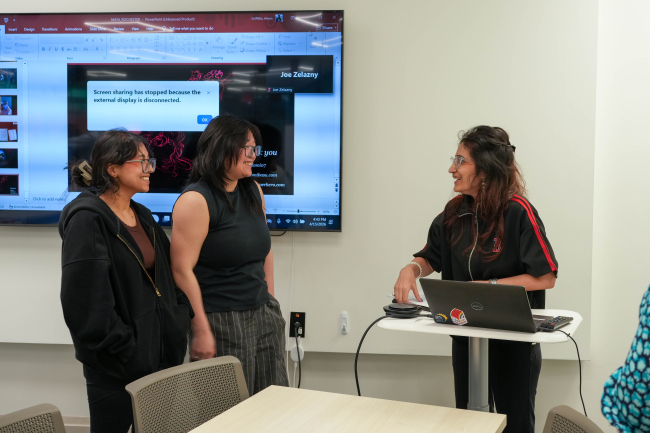
The visit illustrated exactly why the Voices of XR series exists: to bring work that sits at the intersection of emerging technology, the humanities, and social change into conversation with the university community. Through storytelling, Basu moved the discussion beyond technology itself and toward the people and relationships at the center of the story.
And if the technology disappeared for a moment along the way, she suggested, that may have been the point.
Experience Maya at Studio X
If you’d like to experience Maya: The Birth of a Superhero, you can use one of our Meta Quest headsets at home or in our space. Visit Studio X to find out more.


