
Eye tracking and hand tracking supported stroke-diagnostic XR experiment
About the Project
VRTIGO is a collaborative research and development project between the Movement and Plasticity Lab (MAPL) and Studio X. Dr. Ania Busza from MAPL is the principal investigator. Yvie Zhang from Studio X led the experience development. The team investigates how VR headsets can support objective, research-driven workflows for stroke diagnosis.
Dizziness and vertigo are common reasons for emergency department (ED) visits, yet distinguishing the small, high-risk group with central causes (such as stroke) remains highly challenging and time sensitive. VRTIGO provides a VR-based assessment tool designed to help differentiate central vertigo from peripheral vertigo in clinical research settings. The platform captures eye movements, head motion, and fine motor behavior in a standardized, quantitative format.
In a typical scenario, a patient completes guided VR tasks while a clinician observes performance. The system logs rich multimodal data for later analysis and model development.
In Phase 1, we built and piloted a VR assessment battery. In Phase 2, we focused on making the system more robust for real-world research: better eye-tracking reliability, cleaner data synchronization, and improved finger tapping performance logging.
Project Recap
The VR assessment includes tasks adapted from bedside neurological exams:
- Head Stability Test: Assesses postural stability across three visual conditions: solid background, passthrough, and skybox environment.
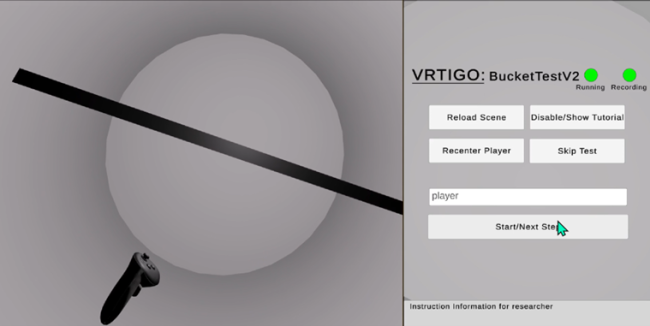
- Bucket Test (Fig BucketTest): Measures subjective visual vertical (SVV) perception—a key indicator of vestibular dysfunction.
- Nystagmus Detection: Tracks involuntary eye movements while patients follow a moving visual target.
- Test of Skew: Detects vertical eye misalignment through alternating monocular occlusion.
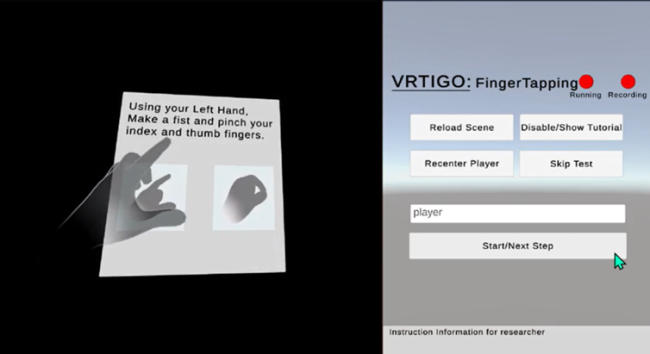
- Finger Tapping Test (Fig FingerTapping): Measures motor coordination and rhythm through rapid index finger-thumb pinching.
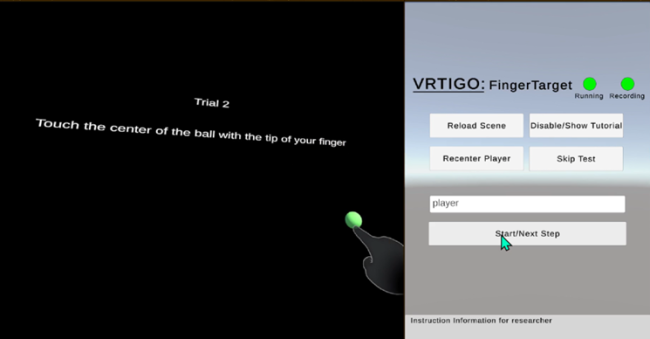
- Finger-to-Target Test (Fig FingerTarget): Assesses spatial accuracy and proprioceptive function through reaching tasks with variable hand visibility.
Together, these tasks capture head pose, eye movements, Fingertip movements, and task-specific signals that may help separate central from peripheral causes of vertigo.
What's New?
Synchronized, High-Frequency Data Logging
In Phase 1, data was logged at inconsistent frequency, making temporal alignment difficult during analysis. In Phase 2, we introduced fixed-step logging with researcher-configurable rates, resulting in more stable and analyzable multimodal datasets.
Refined Finger-to-Target Test Design
The Finger-to-Target Test checks how accurately a person can move their finger to a target. It helps detect issues with coordination—such as overshooting or undershooting—which can signal problems in the part of the brain that controls balance and movement. Initial implementations had inconsistent target placement and incomplete movement trajectory capture. Through three design iterations informed by pilot testing, we greatly enhanced the target placement accuracy and data logging quality by:
- Added calibration phase to normalize for individual arm length differences
- Introduced fingertip tracking for precision measurement
- Implemented continuous trajectory logging at 100 Hz throughout the entire reach-and-return movement
- Added hit detection requiring both proximities to target AND full arm extension to ensure valid reaches
Standalone Eye-Tracking Application
When running via Meta Quest Link (PC-tethered mode), eye tracking would occasionally fail to initialize, resulting in lost data for some participants. To ensure successful research, we developed a standalone version of the eye-tracking-dependent tasks that run entirely on the Quest Pro headset. This version:
- Operates independently without PC connection, eliminating Link-related failures
- Features automated test progression, reducing researcher intervention needs
- Maintains identical data logging specifications as the PC version
Technical Specifications
- Unity 2022.3.45f1
- Built-in Rendering Pipeline
- Meta Interaction SDK
- Meta Quest Pro
Next Steps
Dr. Busza and her lab will continue conducting studies using the current system to collect data and deepen research insights into VR-based stroke diagnosis.
Looking ahead, the team aims to develop an enhanced version of the system with improved performance and potential for clinical application. In parallel, the team is exploring the use of high-end headsets with advanced eye-tracking capabilities to enable more precise diagnostic data collection.

